How to Build a Midnight Sensory Nest for AuDHD Waking Hours
You wake at 2am. Lying in bed, wide awake, teaches your brain that bed means struggle — the same mechanism covered in our sleep performance anxiety guide. But leaving bed only helps if you have somewhere safe and low-effort to go. Without a plan, you end up standing in a bright kitchen at 2am, making decisions your brain is in no state to make.
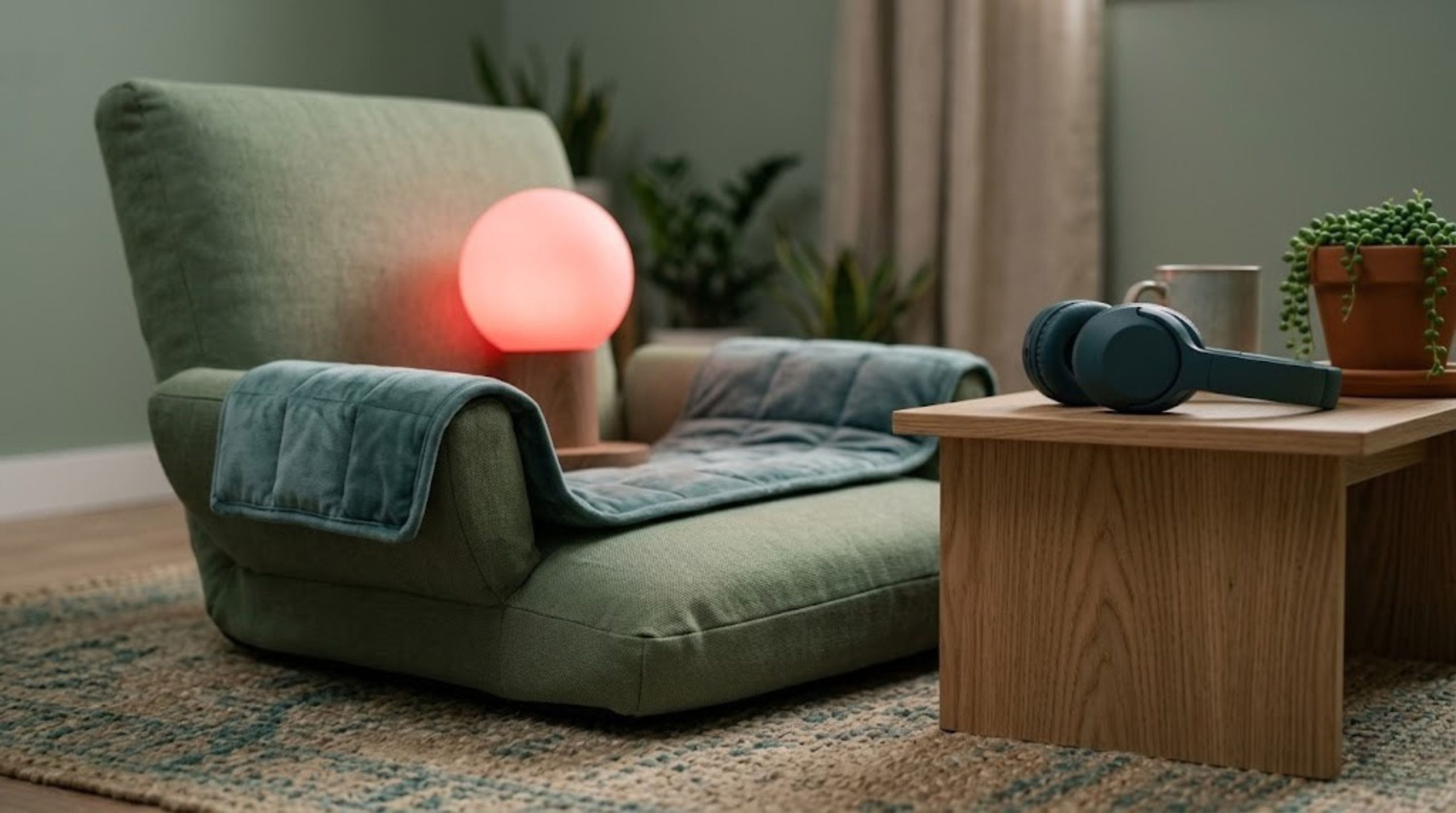
A midnight sensory nest solves this by removing the decisions. Four elements, pre-staged before you need them, so getting up costs zero brainpower.
Why a Pre-Staged Space Matters
Staying in bed while wide awake teaches your brain, over repeated nights, to associate bed with lying there unable to sleep. This is why sleep guidance consistently recommends getting up if you are not asleep within about 20 minutes — not as a punishment, but to protect the bed-equals-sleep association.
The problem is that this advice assumes somewhere calm to go. For an AuDHD brain at 2am, decision-making is already compromised — executive function is lower at 2am than at 2pm for everyone, and more so for ADHD brains specifically. A nest removes the decisions in advance, when your brain has the capacity to make them.
Every choice you have to make at 2am is a choice your sleep-deprived brain is bad at making. Pre-staging removes hunting for the remote, deciding what to watch, or working out where the water glass went — the nest already has an answer for all of it.
Bright or blue-enriched light suppresses melatonin production, which is the opposite of what you want mid-episode. Research measuring this directly found melatonin suppression is almost negligible under roughly 2000K colour temperature — a warm, amber tone — even at meaningful brightness, while blue and green light suppress it substantially even at low intensity.
A single warm-toned lamp (look for ‘warm white’ or amber-tinted bulbs, roughly 2000K or lower) positioned within reach of your nest spot. Avoid overhead lights and phone screens entirely — both skew toward the blue end of the spectrum that most disrupts melatonin.
What wakes you is not simply volume — it is the contrast between a sound and its background. A steady sound at moderate volume is less disruptive than a sudden sound in an otherwise silent room, because your brain reacts to unexpected change, not loudness itself. This is the mechanism behind sound masking: a continuous background sound raises your arousal threshold, so smaller disruptions blend in rather than standing out.
A white or pink noise source already running, or ready to start with one action, in your nest spot. Consistency matters more than the specific sound — whatever you choose, use the same one every time so it becomes a reliable cue rather than another decision.
Firm, distributed pressure shifts the nervous system toward a calmer, parasympathetic state — covered in full in our weighted blanket audit. The relevant point for a nest specifically: whatever provides this for you should already be in place, not something you have to go find at 2am.
A weighted blanket, heavy cushion, or firm wrap already positioned at your nest spot — not stored elsewhere. If a weighted blanket is not for you, a firm hug from a large cushion or tight wrap in a dressing gown engages a similar mechanism.
Something to do that requires close to zero cognitive effort and does not involve a screen. This is a large enough topic to deserve its own full treatment — a separate guide covers specific low-light activities in depth.
What counts as ‘low-demand’ is genuinely individual. For some people that is a physical, repetitive task like sorting or colouring. For others it is passive audio, like a familiar podcast played quietly. Decide this in advance — the whole point of the nest is that you are not deciding at 2am.
- 1Getting up when you cannot sleep protects the bed-sleep association — but only works with somewhere pre-staged to actually go.
- 2Warm light under roughly 2000K colour temperature barely suppresses melatonin, even at meaningful brightness — blue and green light suppress it substantially even when dim.
- 3Sound disruption is driven by contrast against background level, not volume itself — a consistent background sound genuinely changes how disruptive other noises feel.
- 4 should already be in place at your nest spot, not something to locate at 2am.
- 5The specific low-demand activity matters less than deciding on it in advance — the entire value of a nest is removing decisions when your brain is least equipped to make them.
All four elements of a sensory nest work by engaging the same nervous system switch — understanding the full mechanism explains why pressure, warmth, and consistent sound all point the same direction.
Read the Wind-Down Deep Dive