
Why Symmetry & Geometric Pattern Help You Sleep
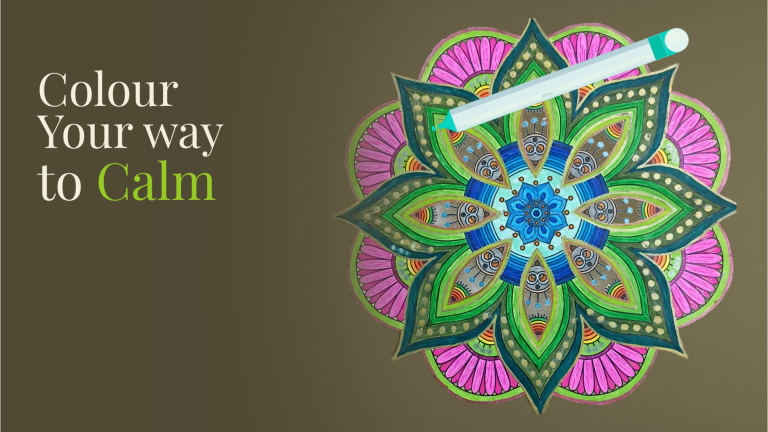
You may have heard that mandalas and symmetrical patterns calm the nervous system, backed by research showing a 60% stress reduction. That figure is real. What it actually measured is not what most articles claim — and the honest version is more useful for your bedroom than the popular one.
The 60% figure comes from Richard Taylor’s research at the University of Oregon — genuine, peer-reviewed, and widely replicated. But Taylor’s work is specifically about : irregular, self-similar patterns found in nature and in art like Jackson Pollock’s paintings, not the radial, evenly-repeating symmetry of a mandala. These are mathematically different kinds of visual structure, and conflating them — as most popular coverage does — overstates what the research actually supports for mandala-style symmetry specifically.
Separately, mandala coloring itself has a genuinely mixed evidence record. The original 2005 study did find a benefit — but even that study found mandala and plaid coloring produced about the same anxiety reduction, both ahead of unstructured drawing. A 2022 systematic review pooling multiple later, larger studies found mandala coloring does not significantly outperform free drawing on anxiety at all, and that the original positive finding has not held up well as more data accumulated.
The evidence supports structured, engaging activity generally reducing anxiety — not mandala symmetry specifically outperforming other structured options. That is a real, useful finding. It is just a different, more modest claim than ‘mandalas are uniquely calming,’ which is what gets repeated.
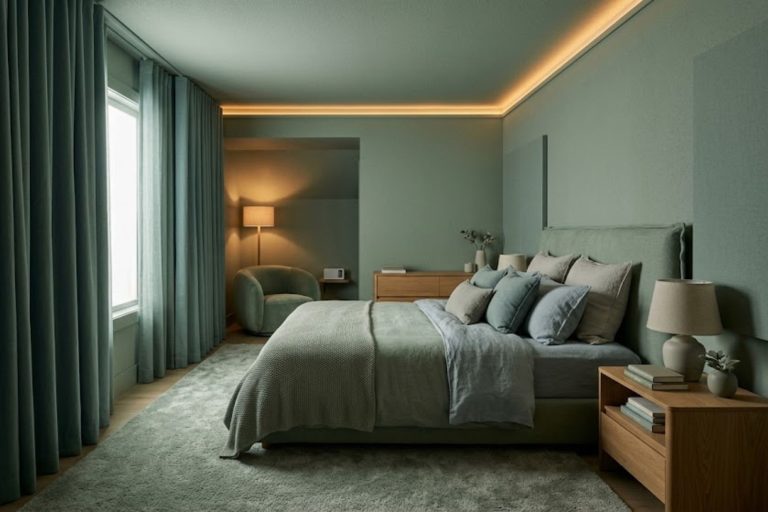
Separate from the coloring-specific research, there is a more modest and better-supported claim: a visually predictable environment reduces ambient cognitive load. Your continues low-level scanning for anything unusual even as you try to sleep. A cluttered, visually irregular room gives it more to scan; a balanced, orderly one gives it less.
This is not about mandalas specifically — it applies to any reasonably ordered visual environment. Symmetrical furniture arrangement, a consistent colour palette, and reduced visual clutter all plausibly work through the same general mechanism: less for a scanning brain to flag as worth attending to.
The genuinely well-supported ND-specific visual research already lives elsewhere on this site — worth reading there rather than a shortened repeat here.
Visual clutter competes for attention alongside everything else — the general decluttering angle covered in our low-contrast sensory sanctuary guide is more directly relevant here than symmetry specifically.
May benefit from both angles at once — reduced clutter for attentional load, plus reduced visual contrast for sensory comfort. Neither depends on the room containing any mandalas specifically.
Autistic visual processing differences are genuine and well-documented, covered in full in our sensory sanctuary guide — but the evidence there is about contrast and predictability broadly, not radial symmetry as a special case.
- Reduce visual clutter before adding pattern — an orderly room does more of the plausible work than any specific decor choice.
- Pick patterns you personally find calming, not mandalas specifically — the evidence does not support one geometric style over another.
- Avoid high-contrast, busy patterns near the bed — this connects directly to the contrast research in our sensory sanctuary guide, and matters more than symmetry does.
- If you enjoy structured coloring as a wind-down activity, the evidence supports it as one reasonable option among several — not as a uniquely superior one. Our coloring for sleep guide covers the activity itself in full.
- 1The well-known 60% stress-reduction figure comes from real research on — irregular, natural patterns — not radial mandala-style symmetry specifically.
- 2A 2022 meta-analysis found mandala coloring does not significantly outperform free drawing on anxiety — the popular claim is more contested than commonly presented.
- 3The more defensible claim is broader: a visually predictable environment reduces ambient scanning — not any one pattern style specifically.
- 4Reducing visual clutter and high-contrast patterns near the bed does more plausible work than adding any specific geometric decor.
- 5Structured, engaging visual activity of any kind — not mandalas uniquely — is what the evidence actually supports.