
The Best Low-Light Activities for the Midnight Watch
The fourth element of a midnight sensory nest is a low-demand activity — something to do at 2am that asks close to nothing of your brain. This is the full list: what actually counts as low-demand, why it differs between ADHD and autism, and specific activities worth having ready.
Why Low-Demand Specifically
At 2am, executive function is at its lowest point of the day. An activity that demands decisions, problem-solving, or sustained attention works against the goal — it keeps the brain engaged rather than letting it wind back down. The activity needs to occupy your hands or attention without asking anything of your judgement.
Many of the activities that work best fall into the category of — repetitive, self-soothing actions. This is not a coincidence. Repetitive, rhythmic actions are theorised to directly engage the vagus nerve, the same mechanism covered in our wind-down deep dive.
The same activity can work well for one profile and do nothing for another — because the underlying need it is meeting is genuinely different.
Often arousal-driven — the brain seeking enough stimulation to settle, rather than too little. An activity with a mild rhythmic or repetitive quality tends to work better than pure stillness, which can feel like understimulation and backfire into restlessness.
Often needs both at once — enough rhythmic engagement to avoid understimulation, delivered through a sensory channel that does not add to overload. This is a narrower target than either profile alone, which is exactly why a pre-tested activity matters more for AuDHD than for either individually.
More often sensory-processing-driven — regulating input level rather than seeking stimulation. A specific texture, sound, or repetitive motion that matches your sensory profile tends to matter more than the activity’s content.
The List
- Textured sorting — sorting buttons, beads, or textured objects by feel, not sight, if lighting is dim.
- Fabric or fidget objects — running fabric through your fingers, a fidget with distinct texture, worry stones.
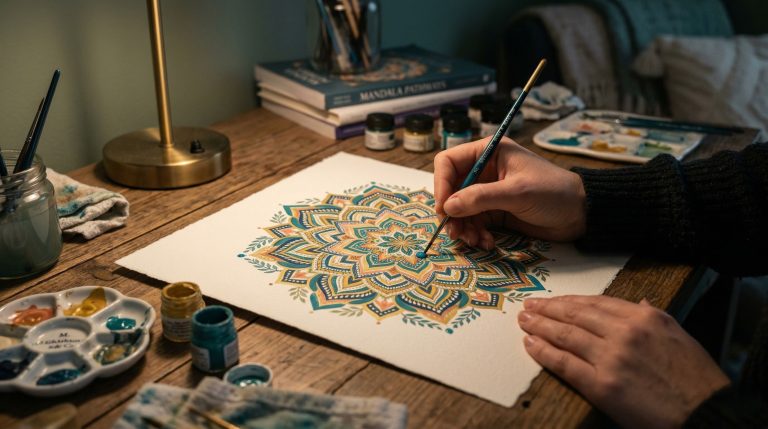
- Simple repetitive craft — knitting a plain row, colouring within established lines, threading beads — nothing requiring new decisions each step.
- A familiar podcast or audiobook — already heard before, so there is no suspense or new information demanding attention.
- Humming or quiet vocalising — directly engages the same vagal pathway as other calming techniques on this site.
- Ambient or instrumental music — no lyrics competing for verbal-processing attention.
- Slow, repetitive rocking in a chair, if available — a well-established self-regulation motion for many autistic and ADHD people.
- Gentle stretching with no goal beyond the movement itself — not exercise, just motion.
- Pacing, if space allows, particularly useful for the ADHD arousal-seeking pattern specifically.
If you already have a known stim that reliably calms you during the day, that is very likely your strongest candidate here — you do not need to discover something new. The nest simply needs it pre-staged and ready, not novel.
Screens undo everything else on this list. Blue-enriched light suppresses melatonin even at low brightness, and the content itself — scrolling, video, most apps — is specifically designed to demand attention, which is the opposite of what a 2am activity should do. If a screen-based activity is the only one that reliably works for you, a dedicated e-reader with a warm, non-backlit display is a meaningfully better compromise than a phone or tablet.
- 1A genuinely low-demand activity asks nothing of judgement or decision-making — the exact resources lowest at 2am.
- 2-adjacent, repetitive actions are theorised to directly engage the vagus nerve — the same mechanism behind most calming techniques on this site.
- 3ADHD activity needs tend to be arousal-driven; autism needs tend to be sensory-processing-driven — the same activity can work for one and do nothing for the other.
- 4If you already have a reliable daytime stim, it is very likely your strongest nest candidate — no need to invent something new.
- 5Screens are the one activity type to avoid without exception — both the light and the attention-demanding content work against everything else on this list.
Stimming, humming, and rhythmic motion all work through the same nervous system pathway — read the full mechanism behind why.
Read the Wind-Down Deep Dive