
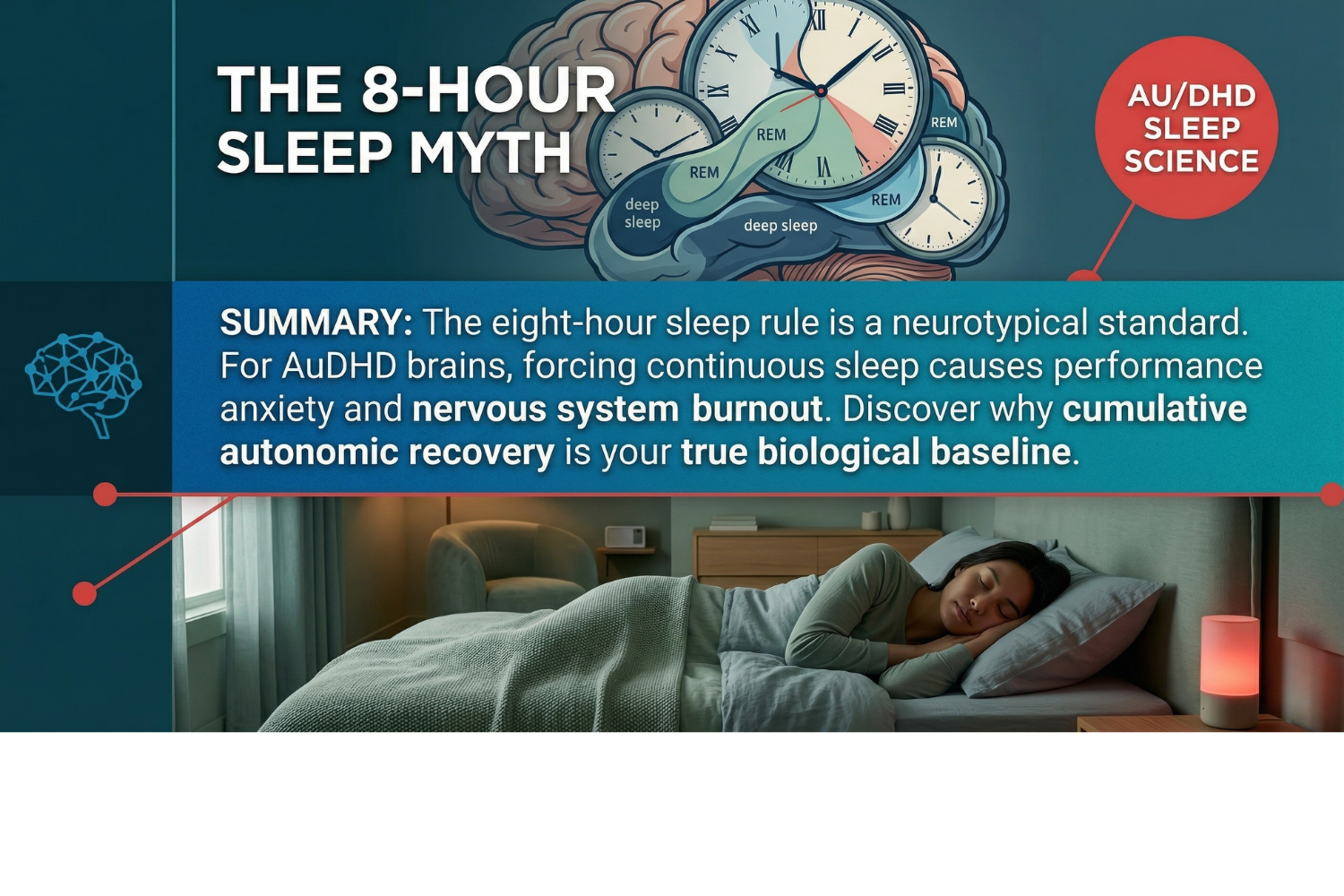
The 8-Hour Sleep Myth: Why Neurodivergent Brains Need a New Blueprint
You slept eight hours. You still feel like you did not sleep at all. This is not a contradiction, and it is not you failing at sleep. Eight hours measures time in bed. It says nothing about what your brain actually did with that time — and for many AuDHD nervous systems, the mechanism that protects sleep from disruption runs differently.
Where “8 Hours” Actually Came From
Sleep guidance for adults has always specified a range — 7 to 9 hours — not a single fixed number. ‘8 hours’ is the popular shorthand for the midpoint of that range, not a precise biological requirement everyone must hit. That distinction gets lost in translation, and the number hardens into a rule that feels like failure the moment you miss it.
But even the range itself measures the wrong thing for this question. Two people can each spend eight hours in bed and have completely different nights, because the number does not capture what happened to their sleep architecture during those hours.
During Stage 2 non-REM sleep, your brain produces brief bursts of activity called — and they do more than support memory consolidation. During a spindle, the thalamus briefly closes a sensory gate, blocking external sound and stimuli from reaching the cortex. Research directly comparing spindle-timed versus non-spindle-timed sound exposure found stimuli delivered during a spindle were significantly less likely to cause arousal.
This is the literal mechanism behind ‘sensory gating that never fully switches off’. Fewer or weaker spindles means the gate closes less often and less completely — meaning more of the ordinary sounds and sensations of a night pass through and register, producing more micro-arousals across a night that still adds up to eight hours on a clock.
Sleep spindle → thalamic sensory gate closes briefly → external stimuli blocked from reaching the cortex → sleep protected from disruption. Fewer or weaker spindles means this protection runs less often — not less sleep by the clock, but less-defended sleep throughout it.
The strength of the evidence differs meaningfully by profile.
Consistently replicated finding: adolescents and children with ADHD show reduced fast sleep spindle activity, associated with poorer overnight memory consolidation. This is one of the more reliable sleep-architecture findings in ADHD research specifically.
Likely inherits the ADHD-linked reduction, though direct AuDHD-specific spindle research is limited. Combined with delayed melatonin onset (covered in our exercise timing guide), this compounds into a sleep window that starts late and stays less protected throughout.
Genuinely inconsistent findings — some studies report reduced frontal spindle activity in autistic infants, while a more recent study found higher spindle amplitude in frontal regions in autistic preschoolers. This is an honest case where the research has not converged, not a gap to paper over with confident claims.
What to Measure Instead
- How you feel on waking, not hours logged — genuinely restored versus groggy despite adequate time in bed is the more honest signal.
- Number of awakenings you notice, even briefly — frequent micro-arousals are the direct signature of reduced sensory gating, whether or not you remember them individually.
- Consistency of your sleep window, not its exact length — a stable schedule supports whatever protective architecture you have; an erratic one undermines even good spindle activity.
- Environmental disruption sources — if your own sensory gating runs weaker, reducing what needs gating in the first place (noise, light, temperature) does more work for you than it would for someone with stronger natural protection.
None of this means eight hours is meaningless, or that duration never matters. It means duration alone is an incomplete metric for an AuDHD nervous system specifically — track how you actually feel and function against your own baseline, not against a number that was never designed with your sleep architecture in mind.
- 1The 7–9 hour guideline was always a range, not a precise nightly target — the popular ‘8 hours’ rule oversimplifies it into a number you can fail.
- 2 function as a literal sensory gate, briefly blocking external stimuli from reaching the cortex during Stage 2 sleep — the actual mechanism protecting sleep from disruption.
- 3ADHD shows consistently reduced fast-spindle activity across multiple studies — a genuinely reliable finding, unlike some other sleep-architecture claims.
- 4Autism spindle research is genuinely mixed — some studies show reduction, one recent study shows increase — worth knowing honestly rather than assuming a clean story.
- 5How you feel, how often you notice waking, and how consistent your schedule is all predict restoration better than hours logged alone.
Sensory gating is one part of a wider nervous system story covered across this site. Read the foundational mechanism.
Read the Wind-Down Deep Dive