The AuDHD Travel Go-Bag: Engineering Sleep in Unpredictable Environments
The first night in a new hotel room is worse than the second, almost universally. This is not superstition or fussiness. It is a measurable, documented brain mechanism — and understanding it changes what actually belongs in a travel bag, from generic comfort items to a deliberately engineered set of familiarity signals.
Why the First Night Is Genuinely Different
Sleep researchers call it the . Neuroimaging shows that on the first night in an unfamiliar environment, one brain hemisphere — typically the left — stays measurably less asleep and more vigilant than the other, functioning as a ‘night watch’ monitoring for unusual sounds or signals. This asymmetry shows up directly in slow-wave activity and produces a stronger, faster response to deviant sounds specifically — ordinary sounds barely register, but an unusual one triggers a sharper reaction than it would in a familiar room.
The effect disappears by the second night in the same environment. This is not the brain being fragile — it is a genuine protective mechanism, similar to how some marine mammals sleep with half the brain active to keep watch. Once the environment is filed as safe and known, the night watch stands down.
Unfamiliar environment → one hemisphere maintains partial vigilance → heightened response specifically to unusual sounds → more arousals, lighter sleep, worse sleep quality — resolving automatically once the brain reclassifies the space as familiar, usually by night two.
Both profiles are affected by unfamiliarity, but the underlying reason — and therefore what actually helps — differs.
Novelty-seeking is a well-documented ADHD trait — and research directly links it to more severe sleep disturbance, particularly in evening-chronotype profiles. The drive toward new places and experiences may be genuinely at odds with the sleep-protective value of familiarity.
Can combine both patterns: genuinely wanting the trip while the nervous system still processes the unfamiliar environment as more taxing once there. Wanting to travel and sleeping well while doing it are not the same question, and treating them as one often leads to unnecessary guilt about needing more preparation than travel companions do.
Processing novel stimuli itself is a documented area of difficulty, distinct from simply preferring routine. This gives insistence on sameness a genuine cognitive basis rather than being merely a preference to override — and suggests the first-night effect’s vigilance response may be both stronger and slower to resolve.
The Go-Bag: Engineering Familiarity
If the mechanism is about the brain classifying an environment as unfamiliar, the fix is to give it familiar signals to classify against — across as many senses as practical.
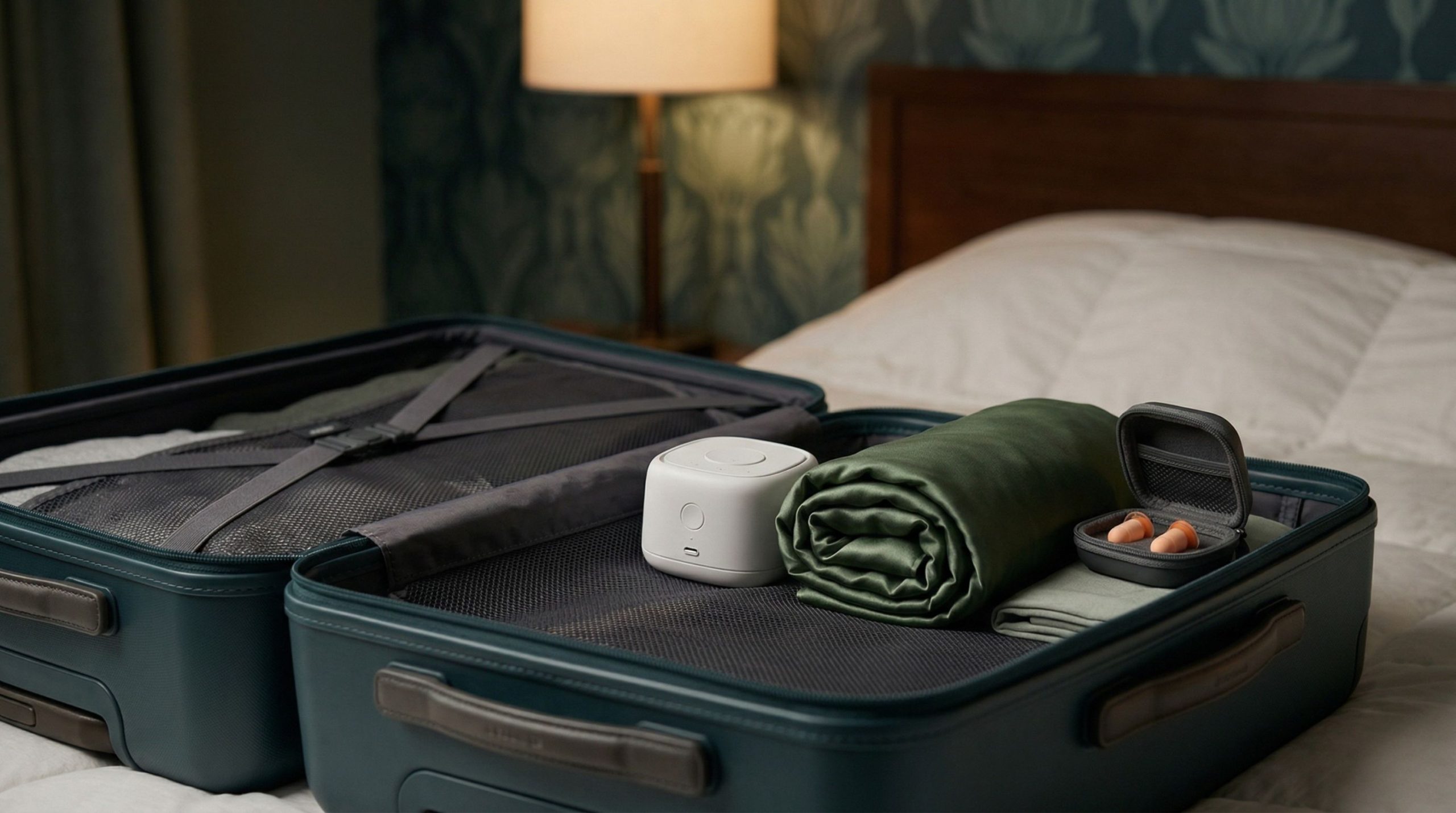
- A consistent scent — the same pillow spray or laundry scent used at home, applied to travel bedding or a pillowcase. Smell is a particularly strong familiarity signal.
- Your own pillowcase, even if the hotel pillow itself stays — texture and scent against the face specifically.
- The same white or pink noise track used at home, not just any white noise — consistency matters more than the specific sound, as covered in our midnight sensory nest guide.
- A sleep mask — standardises the visual environment to near-identical darkness regardless of an unfamiliar room’s actual lighting.
- Deep pressure item — a small weighted item or firm scarf, covered in full in our weighted blanket audit, if packable versions work for you.
Pack this as a dedicated, pre-assembled kit — not items gathered the night before travel. The point is removing decisions when executive function is already stretched by travel logistics, the same principle behind pre-staging a midnight sensory nest.
Which sense matters most for you — smell, sound, touch, light — is individual. If you know your strongest sensory anchor already, prioritise packing for that one fully rather than a thin version of all five. A single well-chosen item you actually use beats a full kit that stays zipped in the bag.
- 1The is a measured, genuine brain mechanism — one hemisphere stays partially vigilant in unfamiliar environments, resolving by the second night.
- 2Autism involves documented difficulty processing novelty itself; ADHD shows novelty-seeking correlating with worse sleep disturbance — different mechanisms, both worth planning around.
- 3A travel sleep kit works by giving the brain familiar signals across multiple senses, reducing how unfamiliar the environment registers.
- 4Scent is a particularly strong familiarity signal, alongside consistent sound, touch, and light standardisation.
- 5Pre-assemble the kit as a standing item, not something gathered under travel-prep pressure — the goal is removing decisions, not adding one more packing task.
The same nervous system switch behind the first-night effect is covered in full in our foundational guide to autonomic regulation and sleep.
Read the Wind-Down Deep Dive