How Caffeine Dictates Your Sleep: Potent Sources & The Half-Life
Caffeine does not simply wear off. It lingers, in a mathematically predictable way, long after you have stopped feeling its alertness — and that lingering amount is often still enough to measurably disrupt sleep, even when you fall asleep without any trouble.
Caffeine works by blocking , the molecule that builds up through the day and creates sleep pressure. It does not stop adenosine from accumulating — it just occupies the receptors adenosine would normally bind to, masking the signal. When caffeine finally clears, the adenosine that built up in the background floods back in, which is part of why an afternoon coffee can produce an evening crash.
The clearance itself follows a predictable curve: caffeine’s averages around 5 hours, though it genuinely ranges from 1.5 to 9.5 hours depending on genetics, liver function, age, and other factors. Have a coffee at 4pm, and roughly half its caffeine is still active in your system at 9pm — a quarter of it remains past 2am.
How Much Is In What You Are Drinking
| Source | Typical serving | Caffeine | Level |
|---|---|---|---|
| Caffeine powder / tablets (NoDoz) | 1 tablet | ~200mg | Very high |
| Starbucks Venti brewed coffee | 20 fl oz | ~410mg | Very high |
| Large energy drink (Bang, similar) | 16 fl oz | ~300mg | Very high |
| Double espresso | 2 fl oz | ~126mg | High |
| Brewed coffee | 8 fl oz | ~95mg | High |
| Standard energy drink (Red Bull, similar) | 8.4 fl oz | ~80mg | High |
| Instant coffee | 8 fl oz | ~60mg | Moderate |
| Black tea | 8 fl oz | ~47mg | Moderate |
| Cola (Coca-Cola, Pepsi, Dr Pepper) | 12 fl oz | ~35–41mg | Moderate |
| Green tea | 8 fl oz | ~29mg | Low |
| Dark chocolate | 1.5 oz | ~25mg | Low |
| Decaffeinated coffee | 8 fl oz | ~2–15mg | Low |
Caffeine content also hides in less obvious places — some pain relievers, pre-workout supplements, and even chocolate-flavoured products contribute meaningfully to your daily total. If sleep is the goal, checking labels on anything consumed in the afternoon is worth the ten seconds it takes.
- 1Caffeine masks signaling rather than stopping it — sleep pressure keeps building in the background regardless.
- 2The average is around 5 hours, but genuinely ranges 1.5–9.5 hours by individual — your own timing may differ meaningfully from the average.
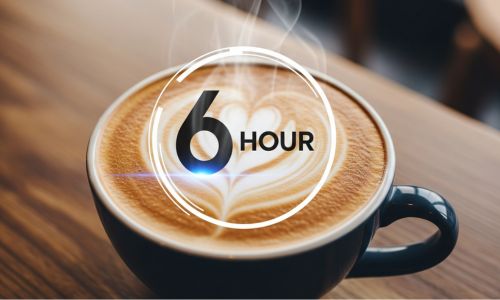
- 3A controlled study found caffeine 6 hours before bed still measurably reduced total sleep — treat 6 hours as a minimum cutoff, not a safe target.
- 4Sleep is best protected with well under 50mg remaining in your system at bedtime.
- 5Caffeine content varies enormously by source — a Venti brewed coffee carries roughly four times a standard cup.